
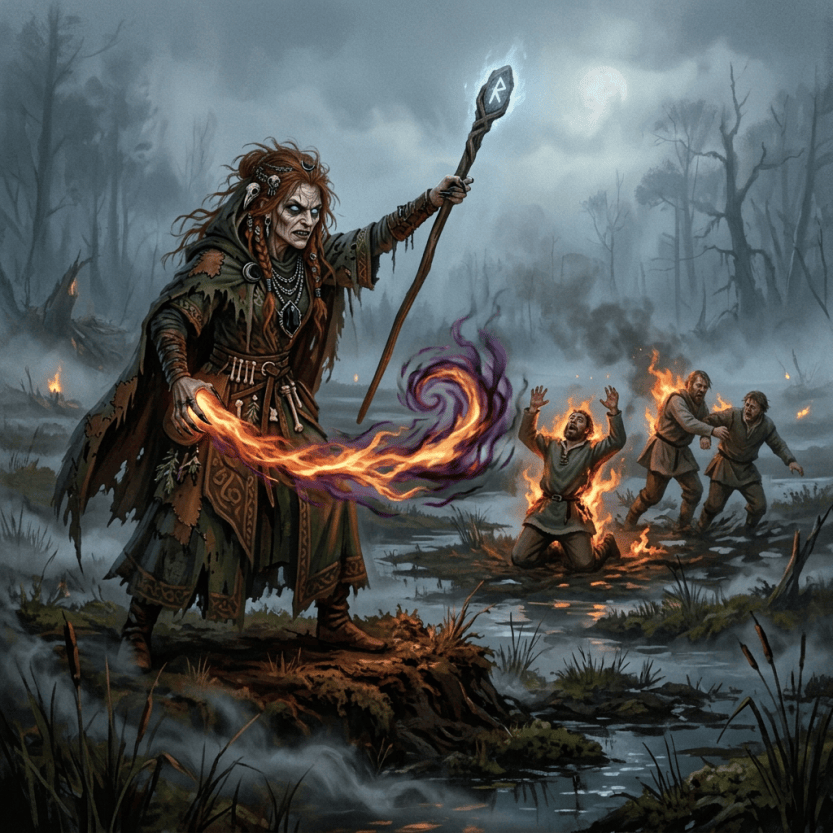
First published in HorrorScope Volume 4.
Bog Hag
Misery be in the air tonight,
hiding within those crimson eyes,
for we cry crystal tears stained with dye,
red as her beating heart,
where the fire lies,
oh yes,
red as her beating heart,
where the fire lies.
Illuminated by the sun’s hot rays, molten dewdrops dripped down an ancient yew’s gnarled branches, hitting the soft soil below with a rhythmic tap tap tapping. Around the tree’s girthy base, the drops cooled in a growing pool, darkening and darkening and darkening, until the drips stopped still and the red blood chilled.
Death had returned to the bog.
Two holy men from a nearby village stood aghast, gazing upon the gruesome scene.
“What devilment has befallen these wetlands?”
“You fret over the land, Tadg? What of the poor soul strung up before us like some beast after the hunt? Do say, what evil has defiled this man’s corpse? Oh, the brutality. The sacrilege!”
A third man pushed through the surrounding foliage. “Perhaps his demise can be attributed to simple misadventure.” He cleared plant debris from his forest green robe and then joined the others.
The man beside him—adorned in the same attire—shook his head. “Brother Cian, only the dimmest stars must shine upon you. How could any man fall prey to a misadventure such as this? Even a blind beggar could see that his entrails have been removed!”
Cian squinted and studied the figure swaying from one of the bigger branches. Sunbeams hugged the back end of the corpse and their marigold fingers reached around the man’s front to illumine his gore-caked torso. Wind strummed the jagged rib bones protruding from his gaping chest cavity; a hollow whistle played among the windswept leaves.
“Golmac, I fear as always, you have seen the truth my failing eyes could not.”
“Perhaps,” Tadg interjected, “it would be best if blindness struck each of us at this moment and all memory of this misery be forgotten.”
Golmac furrowed his brows. “You mean to say we go about our way and shant speak of this again?”
“Speak of what?” Tadg asked, turning from the yew tree and heading back the way they had entered. “And brothers, do not forget the herbs,” he added, picking up his creel containing the efforts of his foraging. “A brighter day shall smile upon us on the morrow.”
The other two men watched as Tadg maneuvered through the wood. Golmac leaned in close to Cian. “I fear no bright days lay ahead,” he whispered, “for a shadow has fallen over this land.” With that, he picked up his creel and followed Tadg’s path.
Cian stood firm, staring at the body. His poor eyesight blurred the details, but in his mind, there was no denying what the men had stumbled upon. There had been a sacrifice. In the name of what God or demon, he could not say, but somewhere, deep in this bog on a foggy night, a man’s heart was ripped free of his breast; his screams no doubt muffled by the dense vegetation.
“May your spirit now rest, brother,” Cian said in a hushed voice.
With little vim in his stride, he worked his way back to the main road and walked along until he caught up with the other two. It was quick going as he had no creel to carry—for he had forgotten it near the mighty yew—but that mattered little after having tasted death’s foul air. He vowed never to return to the bog again.
An afternoon drizzle dampened both the village of Aslen and the mood of its inhabitants. Inside the dim and dreary Dodder’s Tavern, a group of laborers grumbled away the day as they filled their bellies with stale bread and tepid ale. The group sat huddled over a crude wooden table. Their disquiet, made evident by their surly temperament, tainted the Tavern’s normally jovial atmosphere. No man so much as feigned a smile or allowed a peal of laughter to be had.
“Why should one dead man keep food from my family’s mouths?” a laborer lamented. “There is no good reason to stifle a day’s work on his account.”
Another laborer gulped down a mouthful of bitter ale. “I agree, Sean,” he said with a grimace. “Even if a madman lurks around the bog, I see no reason to cancel the day. No matter his cunning or brawn, he be no match for the likes of us. Seven strong men could put down even the most ruthless of assassins if united in the task.” The laborer took a smaller swig of ale but the bitterness was just the same.
“Aye,” Sean agreed.
“Be no madman that stirs the Court to action.” Everyone turned their heads toward the grizzled blacksmith sitting alone at an adjacent table. He was partaking in a humble mid-day meal of meat and oat mash. “If a killer was on the loose, the Royal Guard would hunt him down. I suspect something far more wicked resides in that bog. Something no number of men could stop.”
Sean rubbed his scruffy chin. “Far more wicked, you say? You speak of a beast?”
“Nay.” For several moments, the blacksmith stared silently at his food. “Do you men know the tragic tale of Máire Ó Luain?” he finally asked.
“Know it?” one of the laborers at the far end of the table bellowed. “There is not a man, woman, or child in all of Aslen who has not shed a tear for that poor woman.”
Sean tipped his mug toward the laborer. “Aye.” He then looked back at the blacksmith. “He tells no lies, sir. You know as well as we, few have suffered as Máire Ó Luain. My own mother, when she was but a little girl, paid witness to Máire’s final breaths of life. The memory haunted my dear mother until the day we purified her body with fire and spread her ashes over the sea.”
A young man seated across from Sean cleared his throat. “As you men know,” he said in a loud, clear voice, “My bloodline does not originate here as I had only arrived in Aslen but one year ago. So great in the knowledge that I am lacking, I would be honored, Sean, if you could educate me. I would like to learn of this poor Máire Ó Luain’s fate.”
“My apologies, Fionn. I did not think before I spoke. So much like a brother you have become this past year, I forgot you are not a native of this land and do not know of our histories.”
“No need to apologize,” Fionn said. “You have all welcomed me with such open arms that I want for nothing but to become learned as one born of Aslen.”
“Fair enough.” Sean looked to the blacksmith. “Would you care to grant the boy’s wish and regale us with Máire Ó Luain’s sad tale?”
The blacksmith responded with a single, slow nod.
A low rumble of thunder rattled the windows as fat raindrops began thumping the thatched roof. Flames flickered in the hearth, and all the while the sky darkened and the tavern darkened and the patrons’ moods darkened, blacker and blacker and blacker until only the fire’s orange glow gave muted music for the shadows to perform their grim dance to.
“All of you are too young to have seen Máire Ó Luain in the flesh,” the blacksmith began. “Truth be told, I only laid eyes on her but once myself. When I was a very small boy at that. But she was not a woman one could forget.
“Even when I was a boy, rumor stalked Máire like a hungry wolf. You see,” he paused and took a sip of ale, “it was said that at one time, she was the most beautiful and most coveted woman in all the land. So great was her beauty that noblemen from all over sought her hand in marriage, but she rebuffed them all, choosing a simple life on the bog.
“This caused little harm to her reputation. In fact, quite the opposite. With each man she turned down, her purity and loveliness grew in the minds of the villagers. Eventually, all common folk who gazed upon her were compelled to turn away. No one felt worthy of seeing such perfection. It was thought that to do so would be an affront to the Gods.
“Over time, more and more men demanded her attention. It got to where she could no longer trade goods in Aslen without some man of high standing pulling her aside and whispering sweet nothings in hopes of winning her favor. Through the village, every way she turned, a suitor was sure to follow. But the more hands that reached for her, the more reclusive she became.
“Her home, a crumbling round-house deep in the bog, became a sanctuary for poor Máire. It was the only place where she could go that the men would not follow. That was until the night one vile man, lost in the throes of lust or madness or both, found innocent Máire’s home, and it was there that he stole her beauty and corrupted her purity.”
“You mean to say this man took her chastity?” Fionn asked.
“By force,” the blacksmith replied, his face hard as stone.
“And her beauty? How could one steal that away from a woman?”
The blacksmith swallowed hard. “With fire.”
Outside, the blustering wind battered the tavern with terrible tenacity. If the laborers had not been so engrossed with the blacksmith’s story, they might have rejoiced in having been freed of working in such dire conditions. Perhaps then, their collective mood would have elevated and merriment would have reigned until the setting sun signaled the day’s end. Alas, the tale ensured no cheer would be had.
“The man,” the blacksmith continued, “named Vulcan Volesus, was a Roman patrician who had stopped in Aslen on one of his many travels. Not much is known about him, but it has been said that he was tasked with spreading his culture throughout the land. It was a cruel, violent task, and Vulcan excelled at it by imposing his will upon the innocent. As you men may know, the Volesus name still carries weight in some parts, and that is due to Vulcan’s efficiency at propagating his seed.
“He cared little about marriage, and so the rogue patrician was not interested in taking Máire’s hand. No, the rotten louse, the villain,” the blacksmith rained down a heavy fist upon the table, “all he cared about was destroying beauty! All he desired was to quench his lustful thirst, and Máire was the sweetest wine.
“I will not pretend to know all the details of the night in question. Nor shall I speculate about the events. What I can surmise is that Vulcan Volesus was not entirely successful in executing his dastardly plan.
“That part I know to be true because Máire spoke of it herself. You see, he forced his way into poor Máire’s home and then fell upon her with great violence. But his brutality did not stop there.
“After deflowering her, Vulcan realized consequences would soon follow his actions, even to a man of his standing. To steal the purity of such a coveted woman could only end one way. In death. He accepted this, but being the lecherous dog he was, it was not his death he had in mind.
“This is still a history muddied with rumor, but Máire’s account to the Court described Vulcan’s scheme to dispose of any evidence linking him to his evil deed. That evidence being Máire herself.”
With the afternoon creeping by, the heavy rain slowed, and the heavy slaps on the thatched roof slowed, but the heavy words flowing from the blacksmith’s lips did not slow. It was as if each word was a raindrop, filling the empty basins in the laborer’s minds until the images overflowed and ran down into their hearts.
In detail, he relayed what Máire had supposedly told the Royal Court. About how Vulcan had stalked her for many weeks. How even though she had refused all of his advances, he had persisted. This all culminated with the tragedy that had befallen her.
She told them that Vulcan had ravished her, and how after, he had stripped her naked, taken a switch to her back, and whipped her raw and bloody. And then once his arm had tired and she no longer had a voice to scream with, he had cut her throat with a dagger and removed a piece of flaming timber from the hearth. This he used to set her home ablaze while she lay inside, nude and dying in a pool of her own blood.
What Vulcan did not know, she had told the court, was that in his haste, or due to his lack of combat experience, he had missed cutting her jugular and instead sliced the area beneath her jaw, thus spilling much blood but not killing her. The fire, too, had failed in ending Máire’s life. And though she had been badly burned, the dampness of the bog may have kept her body from mortal injury, even as her home burned to ash around her.
“Even a Roman patrician such as Vulcan Volesus could not escape the noose,” the blacksmith continued. “Once Máire spoke her truth and the people of Aslen learned of Vulcan’s evil acts, the Royal Court had to take action. And take action they did, chasing the fiend to the edge of the bog where they hanged, drawn, and quartered him.”
Fionn raised his index finger in the air. “How was it that Máire made it to Aslen and got herself in front of the Court?”
“That ends the known history,” the blacksmith said in a forlorn voice, “and so the story of how Máire managed to claw her way free of the rubble and speak her truth has been lost to time. However, much gossip has filled in these discrepancies over the years. Most people, as I am sure you men already know, believe that Máire was rescued by Belenus, the God of fire.
“Some say the burns she had suffered were not from the fire, but rather from giving her hand to Belenus in exchange for her life. Since Gods are not subject to the same temptations as man, it is believed that the marriage of flesh took on a ghastly appearance, and it was Máire’s supple skin that showed the result of the fire God’s love rather than her womb.”
With the storm’s end, the small voices of children could be heard outside the tavern. Splish-splash laughs sang sonorously as they played in puddles and pitter-pattered around the wet grounds. But inside, like a tomb’s hush, the men waited quietly for the blacksmith to finish the tale.
“So death spared Máire because she gave herself to the God of fire?” Fionn asked.
“Remember to not seek truth in rumor.” The blacksmith feigned a smile. “As I said, these stories were already hearsay before my birth. Fact cannot be attributed to such tales, but this next part I can speak of with certainty, as I witnessed the events with these two eyes of mine.” The blacksmith pointed to his gray sea storm eyes.
“It was a cold day. Rainy. A kind of sadness hung in the air.” The blacksmith paused, lost in thought. “I did not know much of the world then, being so young, but I knew what I felt that day. Something was wrong. You could see it on the faces of the villagers.
“You see, a child had gone missing the week prior, and the search party had not turned up anything. That was until a lone hunter rushed through Aslen like a whirlwind. ‘The boy, the boy!’ he shouted. ‘In the bog!’
“At the entrance of this very tavern, which was the humble law building in those days, my mother and I watched as the hunter collapsed from exhaustion. ‘It was the Bog Hag. It was the Bog Hag,’ he repeated over and over in a feverish state.
“As I was only a child, I had to stay back while a posse of brave men took to the bog. Anger flushed the men’s faces as the boy’s father led the charge, hollering and riling them up as they set to go down the lonely road toward the wetlands. ‘She may have escaped death long ago, but if she hurt my boy, she will not escape the noose,’ he said to the crowd of onlookers before leaving.
“I feared the worst. For the boy as well as Máire. At the time, rumor had far surpassed the truths of Máire’s past, and so she was thought of as a witch, a hag. This was mostly because of her age and because she no longer left the safety of her home. Few in Aslen had ever seen her, at least not the folk born after her assault. But the occasional hunter who caught a glimpse of the old leather-faced woman of the bog would always spin a yarn. If they saw her collecting water, she was making potions. If she was gathering herbs, she was concocting poisons. You fellows know how talk gets around. A mound becomes a mountain; a brook a river; an old woman living on a bog becomes an evil spell-casting hag. There is no end of faerie stories when fear overruns common sense.
“Anyway, as I said, the men took to the bog. They were not gone but a few hours when a tremendous shriek rose from over the hill. My mother bade me to stay in the house as she hurried outside to see what all the commotion was about. It embarrasses me to confess this, but I did not heed my mother’s command. Instead, I crept outside like a field mouse and hid behind a woodpile.
“As the shriek neared, it turned into a melancholic wail the likes of keening funeral women. That was when I caught my first glimpse of the infamous Bog Hag. It started as blocky shadow figures blotted out by the sun, but soon the shapes escaped the horizon and entered Aslen.”
All the laborers except for Fionn shifted uneasily in their seats as they knew the turn the story had taken.
The blacksmith downed the rest of his ale and then continued. “They had poor Máire’s arms tied behind her and were shoving her along, threatening her neck with a rusted blade tip as they marched. She held her eyes closed, and the most piteous song emanated from deep within the woman. It was as if she knew the end was near and she was keening for her own forfeited life.
“They marched down the dusty road, and all the while the people of Aslen watched on in silence. Some looked grim, some sad, but most appeared to be in awe of Máire. For the witch of the bog, the hag, the stealer of children had been caught.
“From my hiding place, I could see the group walk by without them seeing me, or so I thought. As they neared, on their way to the village square, I noticed a young boy in his father’s arms. The father that had led the charge hung back as another took command. I recognized the boy as an occasional playmate, and though tears streaked his face, he appeared unharmed. The same could not be said for Máire.
“When they walked past my woodpile, I got a good look at the old woman. Mud caked her humble garb, dried blood had crusted around her wrinkled mouth, and what was left of her wet, wiry white hair clung to her badly scarred face.
“Though spared from death in her youth, I think dying in that fire so many years before would have been a mercy. It certainly would have been better than becoming the marred monster Máire had transformed into. The monster that, as they walked by, suddenly opened its eyes and dropped its gaze upon my little face peeking out from behind the woodpile. Even now, I cannot unsee those blood-red eyes. Those crimson orbs threatening to steal my life force.
“I wish I could continue the tale, but so startled was I that I had bolted back into my home, so I did not witness what had occurred next. But if you wish to know,” the blacksmith nodded to Fionn, “I believe Sean can finish what I cannot.”
Sean tipped his mug toward the blacksmith. “A fine job you made of the tale, sir. A fine job.” He then gave his attention to the young man seated in front of him. “I can only repeat the words of my mother and describe what she had seen that day.”
As the men settled in for the long haul, listening with anticipation to a tale most of them already knew, the innocent laughter outside had ceased without notice. A slight commotion commenced, but the patrons of the tavern took no heed.
Sean continued the tale, adding what details the blacksmith had omitted. He mentioned how the young boy had been spotted by the hunter, walking hand-in-hand with the Bog Hag. The boy had told his father that Máire had lured him to her home and was planning to eat him, though he recanted the story later and admitted that the old woman had instead found him, lost and wandering through the dangerous bog alone. The reality was that she had saved the boy, but so ready to dole out punishment was his father that the boy felt compelled to lie to avoid a beating.
The history continued with Máire’s capture, and how the posse marched her to the village square. It was there that she supposedly cursed Aslen as they set her up to hang in the great oak tree.
“My mother also spoke of Máire’s red eyes,” Sean said to the blacksmith. “Like fire, those eyes burned through the hearts of all who watched what they did to her that day. Before they pulled the rope tight around her frail neck, the father of the boy asked if Máire had any final words. She said, ‘From here until the end of time, death shall come to all who enter my bog.’ With that, she continued the sorrowful wailing you had mentioned, ” Sean said to the blacksmith. “I wish the tale ended there,” he looked back at Fionn, “but history is never so kind.
“As soon as they pulled Máire up into that tree, one of the posse members, who had parted from the group upon entering Aslen, returned riding atop a black horse. My mother did not recognize the man, nor did anyone else. The way it was told to me, he had dark, predatory eyes and a long, hooked nose. Tall and lanky with flowing hair black as crow feathers, the man looked to be born not of Aslen, nor to a Roman mother. Also strange were the garments he wore, tight-fitted and oddly colorful like the setting sun, and dangling from his hip was a small bow unlike any used in these parts at the time. It would later come out that none of the posse members knew this man, but they had let him join as he seemed most fervent in finding the Hag.
“Friends,” Sean smiled at the men, “take this next bit with a pinch of salt. My mother had said that the man on the horse charged the tree right as they pulled Máire up by her neck. In a mad blur, The mystery rider hoisted his bow and pulled a black flaming arrow from his quiver. So fast did he charge, one could hardly tell where his body ended and the horse’s began.
“With her red eyes bulging, Máire had not yet let out the guttural death gurgle from the hanging, but death found her all the same as the man set forth the arrow, piercing her heart in one wild rush. The fiery arrow sizzled in her chest while the rider, never slowing, charged past the tree and disappeared behind the gray horizon, never to be seen again.”
“Wait,” Fionn interjected. “The arrow was already on fire when the rider pulled it from his quiver? Surely you meant to say that he somehow lit it as he charged, though that sounds quite preposterous as well.”
“No, my friend, it is just as I said.” A shadow fell over Sean’s face. “All who bore witness claimed that his arrow was on fire the moment he pulled it free of its housing. No explanation has ever satisfied my doubts on the matter, though many believe dark magic had been afoot.
“Regardless, the outcome has been passed down as fact. The flaming arrow pierced the old woman’s heart, killing her before the noose could. Many said the fire burning in her breasts continued long after Máire had been cut down and the arrow removed. Somehow the fire did not spread beyond her heart, and despite the best efforts to put it out, the flame could not be extinguished.”
“He speaks the truth,” the blacksmith said. “I saw it myself during the funeral. They dumped water on her but the fire would not go out. Would not even cool the slightest bit. And when they decided to purify her with a greater flame, hoping to turn her body to ash and return it to the Earth, they found that her corpse was impervious to fire. They could do nothing with it.”
Fionn’s eyes widened. “What happened to her?”
“That,” the blacksmith stood up and draped his cloak over his shoulders, “I do not know. But it is said that holy men took the body back to the bog where she had lived.” He pushed his chair in and headed toward the tavern’s door. “Whether they buried poor Máire Ó Luain or simply left her for the wolves, I cannot say.”
At that, the blacksmith gave a quick wave and then left the tavern, leaving the men to ponder all they had heard.
“Hey,” Sean finally said after several minutes of quiet contemplation. “He never told us why he asked if we knew of Máire’s tale.”
“Yeah,” one of the laborers spoke up. “He said he did not believe the person in the bog was killed by man or beast. Do you think he believed the killer to be—”
Suddenly the tavern door slammed open, and stiff as a stone in the doorway stood Siobhan O’Sullivan, slack-jawed with eyes as wide as silver serving saucers.
“They found another body in the bog!” Siobhan shouted. “A boy!”
With that, as if carried away by a zephyr, she was gone. The laborers, restless, took the news as a call to action.
A miasmic mist lingered around the marshy bog. Deep green trees hung low and obscured a derelict hovel nestled between them. The laborers, accompanied by a dozen villagers, huddled in deliberation.
“So it was a sheep herder who saw the boy?” Sean asked the potter standing next to him.
“Aye.” The potter nervously stared into the shadows shrouding the hovel. Nobody knew of its existence before this day. “Poor lad was hanging from one of them trees, chest torn asunder, or so the herder said. He could not leave his flock to investigate.”
“But there is no body now,” another villager said.
“Surely the killer is in there,” a third villager said, pointing to the hovel.
As the group grew frantic theorizing of what they would find in the mysterious structure, the bog burped up a rotten stench. And then, imperceptibly at first, the hovel exhaled a haunting hymn.
“Hold your tongues,” Sean hollered over the commotion. “Do you hear that?”
The bog burped again and this time a decayed body surfaced. It was the boy.
Fionn, standing on the other side of Sean, pointed to the corpse. “There!”
Before anyone could act, the hushed hovel hymn transmogrified into a resounding screech. The group was startled into silence until the hovel abruptly burst into an acrid flurry of ash. From the destruction, an elder being with flowing crow-feather-hair, dark predatory eyes, and garments the color of the setting sun, glided toward them. Its chest glowed red-hot with an eternal flame, and when the group turned to flee, the being’s chest exploded.
Horrified, the group found they were unable to move. A ring of fire had suddenly surrounded them.
“What is happening?” Fionn yelled.
Without warning, the circle closed in, engulfing the group in fire. The unimaginable heat melted their clothes and bubbled their skin. Their scorched voice boxes were unable to emit a single scream of anguish, and as their eyeballs popped and oozed down their ruined faces, a soft melody rippled through space and time. It was the song of a keening woman. Ethereal and sad, it carried through the evening sky with the beauty from a long lost past.
Immortal made was a desperate woman,
fire filled her heart,
and after her spirit had risen,
this world she could not part.
For when death came near,
the God of Fire took her hand,
his bride he did hold dear,
and so her curse stayed true to the land.

